


Best Cat Travel Carriers for Cars: Safety & Comfort Guide
Table of Contents
- Why Cat Carrier Safety Matters in Vehicles
- Quick Comparison: Best Cat Travel Carriers for Cars
- Crash-Tested Cat Carriers: Maximum Protection on the Road
- Soft-Sided vs Hard-Sided Cat Carriers for Cars: Which Works Best
- Cat Carrier Safety Features for Cars: What to Prioritize
- How to Travel with a Cat in a Car Long Distance: Practical Tips
- Top-Rated Carriers by Travel Scenario
- How to Secure Your Cat Carrier in a Vehicle
Last Updated: July 31, 2026
Finding the best cat travel carriers for cars means balancing safety, comfort, and practicality. A crash-tested carrier can prevent serious injury during sudden stops or accidents. At Pet-MALL, we understand that cat owners need reliable travel gear they can trust, which is why we've analyzed the features that matter most for vehicle safety and feline comfort.
Most guides focus on airline compliance or portability, but they miss what actually protects your cat during car travel. The real challenge is finding a carrier that keeps your pet secure during hard braking, handles temperature swings on long drives, and doesn't stress an anxious animal.
Why Cat Carrier Safety Matters in Vehicles
Your cat's safety during car travel depends on whether the carrier can withstand sudden deceleration and maintain structural integrity during impact. Unrestrained pets become projectiles in accidents, and even minor fender-benders can cause serious injuries when a carrier isn't properly secured. According to research from the Center for Pet Safety, crash-tested carriers reduce injury risk significantly compared to standard soft-sided options.
A carrier that slides across the back seat or tips over during a sharp turn leaves your cat vulnerable. Temperature regulation matters too, cats left in hot cars for even 10 minutes can suffer heat stress, and carriers with poor ventilation trap warm air. Long-distance trips require carriers with mesh panels that allow airflow while keeping your cat contained.
Quick Comparison: Best Cat Travel Carriers for Cars
| Carrier Type | Best For | Key Safety Feature | Price Range |
|---|---|---|---|
| Sleepypod Mobile Pet Bed | Maximum crash protection | Center for Pet Safety certified | $224.99 |
| Sherpa Original Deluxe | Road and air travel | Airline-approved, soft-sided flexibility | $46.04-$84.99 |
| SturdiBag Flexible | Frequent travelers | Fiberglass ribbing prevents collapse | $59.00-$170.00 |
| Pet Gear I-GO2 | Multi-purpose use | 5-in-1 functionality with roller wheels | $34.08-$95.09 |
| K&H Travel Safety Carrier | Car-focused safety | Washable pad, secure restraint design | $62.98-$89.49 |
| AmazonBasics Soft-Sided | Budget-conscious owners | Lightweight, machine-washable liner | $21.99-$54.99 |
Crash-Tested Cat Carriers: Maximum Protection on the Road
Not all carriers protect your cat equally during accidents. A crash-tested carrier has been subjected to impact forces and evaluated for structural integrity, occupant safety, and material durability.
The Sleepypod Mobile Pet Bed is one of the few carriers with crash-test certification from the Center for Pet Safety. Its rigid shell maintains shape under significant force, interior padding absorbs impact energy, and the secure latch system prevents the door from opening during an accident. Crash-tested carriers undergo the same impact scenarios that vehicles experience in real accidents. However, they tend to be heavier and bulkier than soft-sided alternatives, and many carriers marketed as "safe" lack independent crash-test verification. If maximum protection is your priority, seek out carriers with third-party safety certifications rather than manufacturer claims alone.
Soft-Sided vs Hard-Sided Cat Carriers for Cars: Which Works Best
The choice between soft-sided and hard-sided carriers involves trade-offs in flexibility, protection, and comfort.
Soft-Sided Options: Flexibility & Comfort
Soft-sided carriers excel at flexibility. They compress to fit under airline seats, fold for storage, and adapt to tight spaces. The fabric construction allows better ventilation than some hard-sided options, and cats often find the softer interior less stressful.
The Sherpa Original Deluxe exemplifies soft-sided versatility. Its spring wire frame allows compression while remaining airline-compliant, dual entry points give flexibility when loading your cat, and the machine-washable liner makes cleanup easy. However, soft-sided carriers rely on the frame to maintain shape, and a damaged frame loses structural integrity. For car travel, they work best when properly secured with a seatbelt.
Hard-Sided Options: Durability & Structural Integrity
Hard-sided carriers offer superior protection against crushing, puncture, and impact forces. The rigid shell maintains shape regardless of external pressure, and latches are typically more secure than zippers. The SportPet Designs Large Plastic Kennel represents this approach with reinforced plastic shell, metal slats, detachable wheels, and a built-in accident moat. The trade-off is weight and bulk, they're harder to fit into compact vehicles and offer less visibility for your cat, which can increase travel anxiety.
For car travel specifically, hard-sided carriers win on safety and durability. Soft-sided carriers win on convenience and comfort. Choose based on your vehicle size, travel frequency, and your cat's anxiety level.
Cat Carrier Safety Features for Cars: What to Prioritize
When evaluating carriers for car travel, focus on features that directly impact safety and comfort during vehicle movement.
Seatbelt-Compatible Securing Mechanisms
A carrier that slides around during driving is useless, no matter how well-built. Seatbelt-compatible carriers have attachment points or loops that allow you to thread a seatbelt through the carrier, anchoring it to the seat. Look for carriers with reinforced loops on the bottom and sides that are sewn or molded securely, not glued or attached with weak rivets.
Ventilation, Visibility & Interior Padding
Your cat needs airflow during car travel, especially on warm days or long trips. Carriers with mesh panels on multiple sides provide better ventilation than those with solid walls. The mesh also allows your cat to see outside, which can reduce anxiety for some animals. Interior padding absorbs impact energy and provides comfort. Removable and machine-washable padding is essential, your cat may get carsick, and you need to clean the carrier without disassembling it. The K&H Travel Safety Carrier includes a washable comfort pad and mesh windows, balancing ventilation with visibility.
Escape-Resistant Design & Secure Latches
A cat stressed by car travel may try to escape. Carriers with weak zippers or poorly designed doors can be pried open by a determined cat. Look for carriers with self-locking zippers and latches that require deliberate action to open. Hard-sided carriers typically have more secure latches than soft-sided options. Premium YKK zippers are more durable than generic alternatives.
How to Travel with a Cat in a Car Long Distance: Practical Tips
Long-distance car travel with a cat requires planning beyond just choosing a carrier.
Temperature Regulation & Anxiety Management
Cats are sensitive to temperature changes. Keep the carrier in the shadiest part of your vehicle and use sunshades on windows to reduce heat buildup. Never leave your cat unattended in a parked vehicle, temperatures can become dangerous within minutes. For anxious cats, consider calming supplements or pheromone sprays like Feliway. Start using these a few days before travel to help your cat acclimate. Every 2-3 hours, stop and check on your cat. Offer water using a collapsible bowl, but don't force food during active driving.
Multi-Cat Travel Logistics & Carrier Placement
Traveling with multiple cats requires individual carriers to prevent territorial stress. Place carriers on the back seat or in the cargo area, never in the front seat where airbag deployment could injure your cat. Secure each carrier independently with seatbelts.
Top-Rated Carriers by Travel Scenario
Best for Frequent Road Trips: Sherpa Original Deluxe & SturdiBag
If you're driving with your cat multiple times per month, you need a carrier that's durable, easy to clean, and comfortable for repeated use. The Sherpa Original Deluxe has been trusted by travelers for years. Its spring wire frame provides structure without excessive weight, and the machine-washable liner handles inevitable accidents and shedding. The SturdiBag Flexible Carrier offers similar benefits with added durability, tougher 600D fabric, and YKK zippers that hold up to repeated opening and closing.
Best for Anxious Cats: Pet Gear I-GO2 & K&H Travel Safety
Anxious cats benefit from carriers that offer comfort features and reduce visual stress. The Pet Gear I-GO2 Traveler Roller Backpack is designed with anxious pets in mind, featuring a fleece-top comfort liner, expandable sides, and included tether. The K&H Travel Safety Carrier is specifically designed for car travel with a washable pad, mesh ventilation, and secure design that creates a calming environment.
Best Value Without Compromise: AmazonBasics & SportPet Designs
Budget-conscious owners don't have to sacrifice safety. The AmazonBasics Soft-Sided Pet Travel Carrier offers solid construction at a lower price point with mesh ventilation, removable fleece pad, and seatbelt-compatible design. The SportPet Designs Large Plastic Kennel offers excellent value for hard-sided carriers with reinforced plastic shell, detachable wheels, and IATA airline compliance. Neither carrier has crash-test certification, but both offer solid construction and practical features.
How to Secure Your Cat Carrier in a Vehicle
Proper securing is where many cat owners fail. A carrier that isn't anchored to the vehicle can become a hazard during sudden stops, turns, or accidents.
Seatbelt Installation & Stability Testing
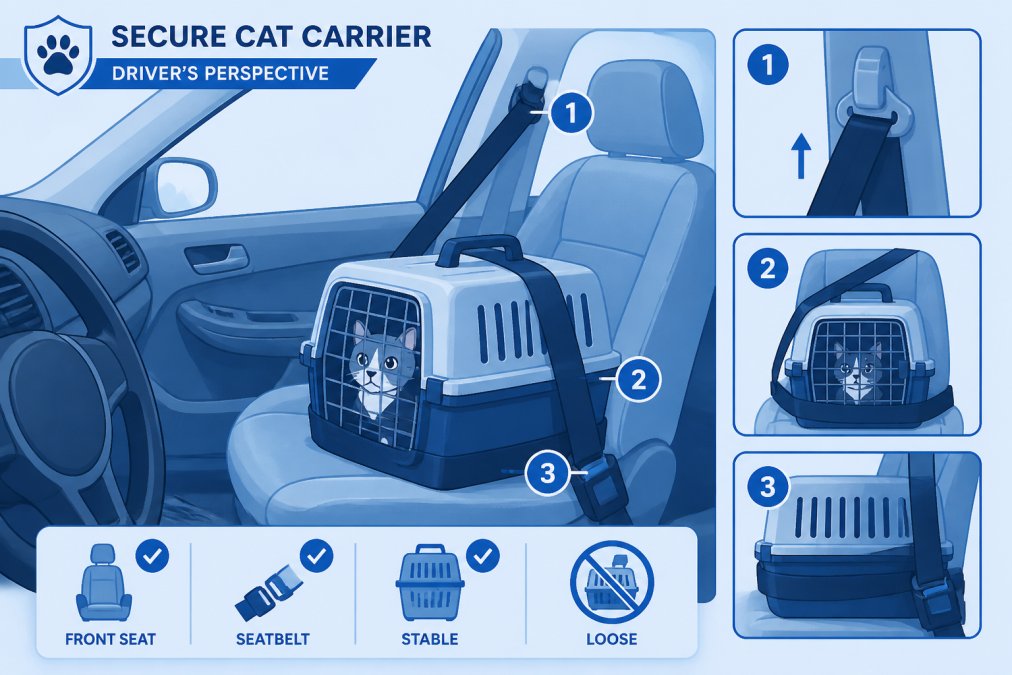
The most common securing method is threading the vehicle's seatbelt through the carrier's attachment loops. Position the carrier on the seat where you want it to stay. Thread the seatbelt through the loops on the bottom and sides of the carrier, ensuring the belt passes through multiple attachment points for even distribution of force. Tighten the seatbelt fully, it should be snug enough that you can't shift the carrier by hand. Test the carrier by trying to move it forward, backward, and side to side. If it moves more than an inch, adjust the seatbelt routing or try a different position. For larger hard-sided carriers, you may need to use multiple seatbelts or a cargo net in addition to seatbelts.
Avoiding Common Securing Mistakes
The most common mistake is relying on a single seatbelt attachment point. If the carrier is only anchored at one point, it can rotate or tip during turns or sudden stops. Always use at least two attachment points, typically the bottom and one side. Another mistake is not tightening the seatbelt fully. Never place carriers on the front passenger seat, if the airbag deploys, it can injure or kill your cat. Always place carriers on the back seat or in the cargo area.
Frequently Asked Questions
What type of cat carrier is safest for car travel?
Crash-tested carriers like the Sleepypod Mobile Pet Bed offer the highest safety standard, certified by the Center for Pet Safety (CPS). Hard-sided carriers with structural integrity also provide excellent protection. For maximum security, look for carriers with secure latches, seatbelt-compatible designs, and crash-tested certification. Soft-sided carriers offer comfort but less structural protection in accidents, so prioritize your safety needs when choosing.
How do I secure a cat carrier in a car?
Use your vehicle's seatbelt to secure the carrier to the seat, ensuring it cannot slide or tip during sudden stops. Position the carrier on a rear seat away from airbags. Check that the seatbelt passes through or around the carrier's securing mechanism. Test stability by gently pushing the carrier, it should not move. For carriers with built-in anchoring points, use those first. Never place carriers on the front seat or loose in the cargo area, as they can become projectiles during accidents.
Are soft-sided or hard-sided carriers better for car travel?
Hard-sided carriers offer superior crash protection and structural integrity, making them ideal for car safety. Soft-sided carriers provide comfort, flexibility, and lighter weight, but offer less protection in accidents. The best choice depends on your priorities: choose hard-sided for maximum safety on regular road trips, or soft-sided if you need portability and your cat experiences travel anxiety. Many owners use crash-tested soft-sided options like the Sleepypod as a compromise between safety and comfort.
What features should I look for in a car cat carrier?
Prioritize crash-tested certification, seatbelt-compatible securing mechanisms, and secure latches to prevent escape. Look for adequate ventilation with breathable mesh, interior padding for comfort, and washable liners for easy cleaning. Weight capacity should accommodate your cat with room for movement. Visibility windows reduce travel stress. For long-distance trips, consider collapsible designs for storage and carriers that double as beds to help your cat acclimate and reduce anxiety during transit.
How can I help my cat stay calm during long car trips?
Use a familiar carrier that your cat has practiced in at home to reduce travel stress and anxiety. Maintain comfortable temperature regulation by avoiding direct sunlight and using air conditioning. Place the carrier on a stable surface and secure it properly to minimize motion-sickness triggers. Consider using a carrier that doubles as a bed, allowing your cat to acclimate before the trip. Keep trips gradual, start with short drives. For multi-cat travel, use separate carriers to reduce stress and prevent conflicts.
Choosing the right cat travel carrier for cars requires balancing safety, comfort, and practicality. Pet-MALL offers a curated selection of premium travel gear designed to keep your cat secure and comfortable during vehicle trips. With features like crash-test certification, seatbelt-compatible securing mechanisms, and machine-washable liners, Pet-MALL carriers give you confidence that your cat is protected. Explore our collection today and find the carrier that matches your travel needs.
This article was written using GrandRanker
Shop General Pet Care & Behavior: Browse our General Pet Care & Behavior collection for products picked to match what you just read.