


Best Interactive Dog Puzzle Toys: Top Picks for 2026
Table of Contents
- Why Mental Stimulation Matters for Dogs
- How to Choose the Right Interactive Dog Puzzle Toy
- Treat-Dispensing vs. Sliding Puzzle Mechanisms
-
Top Interactive Dog Puzzle Toys Compared
- Outward Hound Hide N' Slide: Best for Intermediate Problem-Solvers
- Nina Ottosson Tornado: Best for Rotating Disc Challenges
- KONG Classic: Best Versatile Treat-Dispensing Option
- StarMark Bob-A-Lot: Best for Slowing Fast Eaters
- PetSafe Busy Buddy Kibble Nibbler: Best for Customizable Difficulty
- Trixie Activity Flip Board: Best Budget-Friendly Strategy Game
- Planet Dog Orbee-Tuff Snoop: Best Durable Scent-Based Puzzle
- West Paw Zogoflex Toppl: Best Customizable and Eco-Friendly
- Snuffle Mats for Dogs: Natural Foraging Enrichment
- Safety, Supervision, and Maintenance
- Troubleshooting Common Puzzle Toy Problems
- Integrating Puzzle Toys Into Training and Daily Routines
Last Updated: August 2, 2026
When it comes to keeping dogs mentally engaged and physically active, the best interactive dog puzzle toys reduce boredom, manage anxiety, and strengthen the bond between pet and owner. At Pet-MALL, we've curated a comprehensive selection of these enrichment toys to help dog owners make informed choices. Dogs without adequate mental stimulation develop destructive behaviors, excessive barking, and anxiety-related issues. This guide covers everything you need to know about selecting, using, and maintaining interactive dog puzzle toys.
Why Mental Stimulation Matters for Dogs
Mental enrichment is a fundamental need that directly impacts dogs' physical health, emotional well-being, and behavior. Dogs are problem-solving animals descended from wolves that spent their days hunting and navigating complex environments. Without cognitive challenges, they experience stress and boredom that manifests as destructive chewing, excessive barking, and anxiety-related behaviors.
Interactive puzzle toys activate the brain in ways regular play cannot. They require dogs to use natural instincts, foraging, sniffing, and manipulating objects, while working toward a reward. Veterinarians and certified dog trainers recommend puzzle toys as a first-line intervention for mild separation anxiety before considering medication. Studies on canine cognition show that dogs engaging in regular problem-solving maintain sharper mental function as they age.
How to Choose the Right Interactive Dog Puzzle Toy
Selecting the right puzzle toy requires balancing three factors: your dog's experience level, their physical size and chewing style, and the type of mental challenge that will keep them engaged.
Matching Difficulty to Your Dog's Experience Level
Dogs new to puzzle toys need early success to build confidence. A toy that's too difficult discourages engagement; one that's too simple becomes boring quickly.
Level 1 (Beginner): Minimal manipulation required with generous rewards. Ideal for puppies, senior dogs, or dogs encountering puzzle toys for the first time.
Level 2 (Intermediate): Multiple steps or techniques required, sliding compartments, rotating discs, or flipping lids. Appropriate for dogs who've mastered basic puzzle toys and can sustain focus for 5-10 minutes.
Level 3 (Advanced): Sustained problem-solving with multiple sequential steps. Designed for highly motivated, intelligent dogs or those using puzzle toys for months.
Considering Your Dog's Size and Chewing Style
Toy size must match your dog's mouth and body. Check manufacturer size recommendations carefully, they're based on safety, not just comfort. Chewing style matters equally. Gentle manipulators use paws and noses to solve puzzles; aggressive chewers destroy toys rapidly. For power chewers, look for toys made from durable, non-toxic materials like reinforced rubber or hard plastic.
Dogs with high food motivation excel with treat-dispensing toys, while dogs less interested in food may prefer puzzle toys engaging natural foraging instincts through scent work.
Treat-Dispensing vs. Sliding Puzzle Mechanisms
Treat-dispensing toys reward effort directly. As your dog manipulates the toy, treats fall out at intervals. The immediate, tangible reward makes these toys highly motivating for food-driven dogs and ideal for dogs new to puzzle toys.
Sliding puzzle mechanisms require your dog to understand cause-and-effect relationships more explicitly. Your dog must lift, slide, or rotate compartments to reveal hidden treats. These toys demand more deliberate problem-solving and often hold a dog's interest longer.
Choose based on your goal. For extending mealtime and basic enrichment, treat-dispensing toys are efficient. For deeper cognitive engagement and repeated use over weeks, sliding puzzle mechanisms are superior.
Top Interactive Dog Puzzle Toys Compared
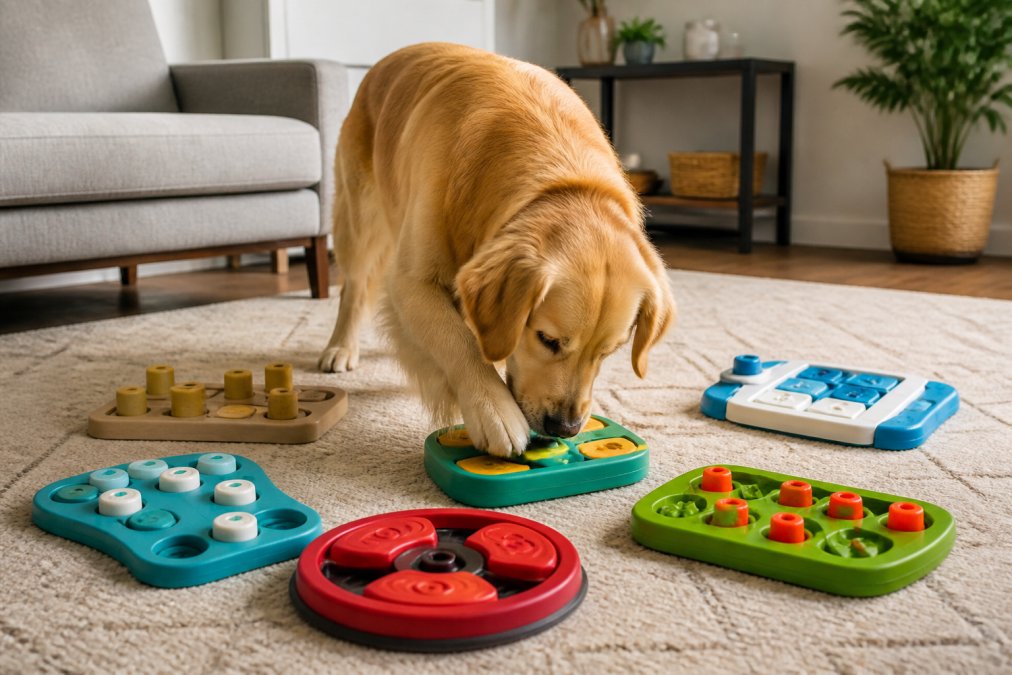
Outward Hound Hide N' Slide: Best for Intermediate Problem-Solvers
The Outward Hound Hide N' Slide features 14 treat compartments hidden under swiveling flippers and sliding wooden blocks, requiring multiple techniques to access treats. The non-slip rubber base prevents sliding, allowing your dog to focus on problem-solving. Made from food-safe, BPA-free composite wood with no small parts, it withstands moderate chewing.
Pros: Engages problem-solving with varied hiding techniques. Durable construction with non-slip base.
Cons: May become too easy for highly motivated dogs. Not suitable for aggressive chewers.
Nina Ottosson Tornado: Best for Rotating Disc Challenges
The Nina Ottosson Tornado features three tiers of spinning discs your dog must rotate to align treat compartments. Three bone-shaped covers increase difficulty as your dog learns, extending the toy's usefulness. Translucent plastic lets you see treat placement and guide initial attempts.
Pros: Rotating mechanism engages different problem-solving skills. Adjustable difficulty with included covers.
Cons: Some dogs figure out rotation mechanics quickly. Discs can be knocked over by larger dogs.
KONG Classic: Best Versatile Treat-Dispensing Option
The KONG Classic is a hollow rubber toy designed to be stuffed with kibble, wet food, or treats. You can fill it with dry treats for quick engagement or freeze it with wet food for longer-lasting challenge. Available in multiple sizes from X-Small to XX-Large, with an Extreme version for power chewers.
Pros: Extremely durable for average chewers. Versatile filling options. Recognized by veterinarians worldwide.
Cons: Difficult to clean thoroughly. Not indestructible for power chewers.
StarMark Bob-A-Lot: Best for Slowing Fast Eaters
The StarMark Bob-A-Lot wobbles and bobs as your dog pushes it, releasing kibble through adjustable openings. The weighted base creates unpredictable wobbling that mimics natural hunting. Holds up to 3 cups of food for complete meals.
Pros: Customizable difficulty. Holds a full meal. Weighted base creates engaging motion.
Cons: Can be noisy on hard floors. Requires more space than stationary toys.
PetSafe Busy Buddy Kibble Nibbler: Best for Customizable Difficulty
The PetSafe Busy Buddy Kibble Nibbler uses a patented Treat Meter that randomly dispenses treats as your dog pushes and rolls the toy. Flexible prongs can be trimmed to customize difficulty. Holds up to 3.5 cups of kibble and is dishwasher-safe.
Pros: Customizable difficulty through prong trimming. Dishwasher-safe. Holds a full meal.
Cons: May be too easy for highly motivated dogs. Randomness can frustrate dogs preferring predictable mechanics.
Trixie Activity Flip Board: Best Budget-Friendly Strategy Game
The Trixie Activity Flip Board features two cones and multiple compartments with hinged and sliding lids. Your dog must figure out different techniques to open each compartment. Non-slip rubber feet keep it stationary. Affordable pricing makes it excellent for testing whether your dog engages with puzzle toys.
Pros: Affordable with genuine puzzle challenge. Non-slip base. Suitable for puppies and small to medium dogs.
Cons: Cones can be knocked over by larger dogs. May be too simple for advanced problem-solvers.
Planet Dog Orbee-Tuff Snoop: Best Durable Scent-Based Puzzle
The Planet Dog Orbee-Tuff Snoop engages your dog's most powerful sense: smell. This translucent, squishy toy has a deep crevice designed to conceal treats, requiring sniffing and pawing to retrieve them. Scent-based puzzles activate different neural pathways than mechanical puzzles.
Pros: Engages natural sniffing and foraging instincts. Durable, soft material. Easy to clean.
Cons: Not designed as a chew toy. Requires supervision.
West Paw Zogoflex Toppl: Best Customizable and Eco-Friendly
The West Paw Zogoflex Toppl combines customization, durability, and environmental responsibility. Made in the USA from durable, recyclable, non-toxic Zogoflex material, it features inner ridges that trap treats. The modular design lets you interlock different sizes to increase difficulty. West Paw backs it with a one-time replacement guarantee.
Pros: Highly customizable through modular interlocking. Made in the USA from recyclable materials. One-time replacement guarantee.
Cons: Premium pricing. Different sizes purchased separately.
| Toy | Best For | Difficulty Level | Key Feature | Durability |
|---|---|---|---|---|
| Hide N' Slide | Intermediate solvers | Level 2 | Multiple hiding techniques | Excellent |
| Tornado | Rotating disc fans | Level 2 | Adjustable with bone covers | Very Good |
| KONG Classic | Versatile use | Level 1-2 | Fillable, freezable | Excellent |
| Bob-A-Lot | Fast eaters | Level 2 | Adjustable openings | Very Good |
| Kibble Nibbler | Customizable needs | Level 1-2 | Trimable prongs | Excellent |
| Flip Board | Budget-conscious | Level 2 | Multiple lid types | Good |
| Orbee-Tuff Snoop | Scent work lovers | Level 1-2 | Deep crevice design | Excellent |
| Zogoflex Toppl | Eco-conscious | Level 1-3 | Modular stacking | Excellent |
Snuffle Mats for Dogs: Natural Foraging Enrichment
Snuffle mats engage your dog's natural foraging instincts by requiring them to use their nose and paws to search through fabric strips for hidden treats or kibble. With no moving parts to break, they're simple and effective. Your dog's powerful sense of smell activates the same neural pathways that scent detection dogs use in training. Many dogs find snuffling deeply calming, making snuffle mats valuable for anxious dogs.
Snuffle mats come in various designs with fringe, tassels, cups, pockets, or layered petals creating different difficulty levels. They're suitable for dogs and cats of any age and are usually machine washable. The primary limitation is that snuffle mats aren't suitable for aggressive chewers who might tear the fabric.
Safety, Supervision, and Maintenance
Materials That Keep Your Dog Safe
Non-toxic, BPA-free, and phthalate-free plastics are standard in quality toys. BPA (bisphenol A) is an industrial chemical linked to health concerns; phthalates are plasticizers that can leach from soft plastics. Quality manufacturers avoid these chemicals entirely.
Natural rubber toys like KONG are inherently safer than synthetic materials because rubber doesn't contain chemical additives. However, synthetic materials like Zogoflex can be engineered to be completely non-toxic and durable. Avoid toys with small parts that can be chewed off and swallowed, paint or dyes that might be toxic, or materials that splinter easily.
Cleaning and Long-Term Care
Most puzzle toys benefit from regular cleaning to prevent bacterial growth. Treat residue can accumulate in crevices, creating conditions for mold or bacteria. Toys used daily should be cleaned at least weekly with warm soapy water, paying special attention to crevices and compartments.
Many modern puzzle toys are dishwasher-safe; check manufacturer instructions. Inspect toys regularly for damage. Cracks, missing pieces, or rough edges warrant replacement. Rotate toys periodically, putting away a toy for a few weeks and reintroducing it later often reignites your dog's interest.
Troubleshooting Common Puzzle Toy Problems
Your dog ignores the puzzle toy entirely. The most common cause is difficulty mismatch. Try a simpler toy first, or show your dog how treats fall out by manipulating the toy yourself. Use higher-value treats than regular kibble.
Your dog solves the puzzle in 30 seconds and loses interest. The toy is too easy. Advance to the next difficulty level or add difficulty modifications. Use smaller treats that take longer to extract.
Your dog becomes frustrated and abandons the puzzle. The toy is too difficult. Move back to an easier toy and rebuild confidence.
Your dog destroys the toy within days. Your dog is a power chewer and needs toys designed for that behavior. The Orbee-Tuff Snoop and KONG Extreme are better choices. Rotate toys frequently.
Your dog won't eat from the toy. Some dogs are suspicious of new objects. Try placing the toy next to their regular food bowl for a few days. Hand-feed treats from the toy to build positive associations.
The toy develops a smell or visible mold. Increase cleaning frequency to at least weekly. Ensure toys are completely dry before storage. If mold persists, replace the toy.
Integrating Puzzle Toys Into Training and Daily Routines
Puzzle toys are most effective when incorporated into daily routines rather than used sporadically. Consistency matters more than intensity.
Mealtime enrichment: Replace one or two regular meals per week with puzzle toy meals. This transforms feeding from a 5-minute event into a 20-30 minute enrichment activity.
Training integration: Use puzzle toys as rewards during training sessions. A dog that solves a puzzle toy and receives a treat experiences reinforcement from both the puzzle-solving success and the reward.
Anxiety management: For anxious dogs, puzzle toys provide constructive focus during stressful periods. A dog anxious about your departure might be calmer if given a challenging puzzle toy right before you leave.
Rotation strategy: Keep 4-6 puzzle toys in rotation, using each one for a week before rotating to the next. This prevents habituation; toys become "new" again after time away.
Finding the right interactive dog puzzle toys transforms daily routines into enrichment opportunities that keep your dog mentally sharp, physically active, and emotionally balanced. The toys covered in this guide represent the best options across different difficulty levels, mechanisms, and price points. At Pet-MALL, we understand that every dog has unique preferences and needs. Start with a simpler toy to build confidence, observe which mechanisms your dog engages with most enthusiastically, and gradually introduce more challenging options as their skills develop. With the right puzzle toy strategy, you'll see improvements in behavior, reduced anxiety, and a dog that's genuinely excited about enrichment time.
Frequently Asked Questions
What are the main benefits of interactive dog puzzle toys for mental stimulation?
Interactive dog puzzle toys provide mental stimulation that reduces boredom and destructive behaviors. They engage your dog's natural problem-solving instincts and foraging behaviors, helping tire out their mind as much as physical exercise tires their body. Dogs using these toys regularly show improved impulse control, reduced anxiety, and better overall behavior. Mental enrichment through puzzle play is especially valuable for senior dogs, puppies during development, and dogs prone to separation anxiety.
How do I choose the right difficulty level for my dog's puzzle toy?
Start with Level 1 (beginner) puzzles if your dog is new to interactive toys. Level 2 (intermediate) suits dogs who have mastered basics and need more challenge. Watch your dog's engagement: if they solve it in under 5 minutes repeatedly, increase difficulty. If frustration builds after 15 minutes without success, step back a level. Many owners use multiple toys at different difficulty levels and rotate them to maintain interest and prevent boredom.
What's the difference between treat-dispensing dog toys and sliding puzzle mechanisms?
Treat-dispensing toys like the KONG Classic and StarMark Bob-A-Lot release food as dogs manipulate them, rewarding effort immediately. Sliding puzzle mechanisms like the Hide N' Slide require dogs to move blocks or flippers to uncover hidden treats, demanding more deliberate problem-solving. Treat-dispensing toys work well for fast eaters and anxiety relief, while sliding puzzles better develop cognitive skills. Many owners use both types to provide varied enrichment.
Are puzzle toys safe for dogs, and what should I look for?
Quality puzzle toys are safe when made from non-toxic, BPA-free materials like those used by Outward Hound, West Paw, and KONG. Always supervise play, especially initially, to ensure your dog doesn't chew toy parts off. Choose toys appropriate for your dog's size and chewing strength. Hand wash most toys with warm soapy water after use to prevent bacterial growth. Replace toys showing cracks or damage. Avoid toys with small removable parts that pose choking hazards.
How can snuffle mats for dogs complement other interactive toys?
Snuffle mats engage your dog's powerful sense of smell and natural foraging instincts differently than mechanical puzzles. They're ideal for slowing down fast eaters, providing low-stress enrichment, and reducing anxiety. Use snuffle mats alongside puzzle toys to create varied enrichment routines. Snuffle mats work well for senior dogs or those recovering from injury since they require minimal physical exertion. Rotate between snuffle mats and puzzle toys to maintain novelty and sustained mental engagement.
This article was written using GrandRanker
Shop General Pet Care & Behavior: Browse our General Pet Care & Behavior collection for products picked to match what you just read.